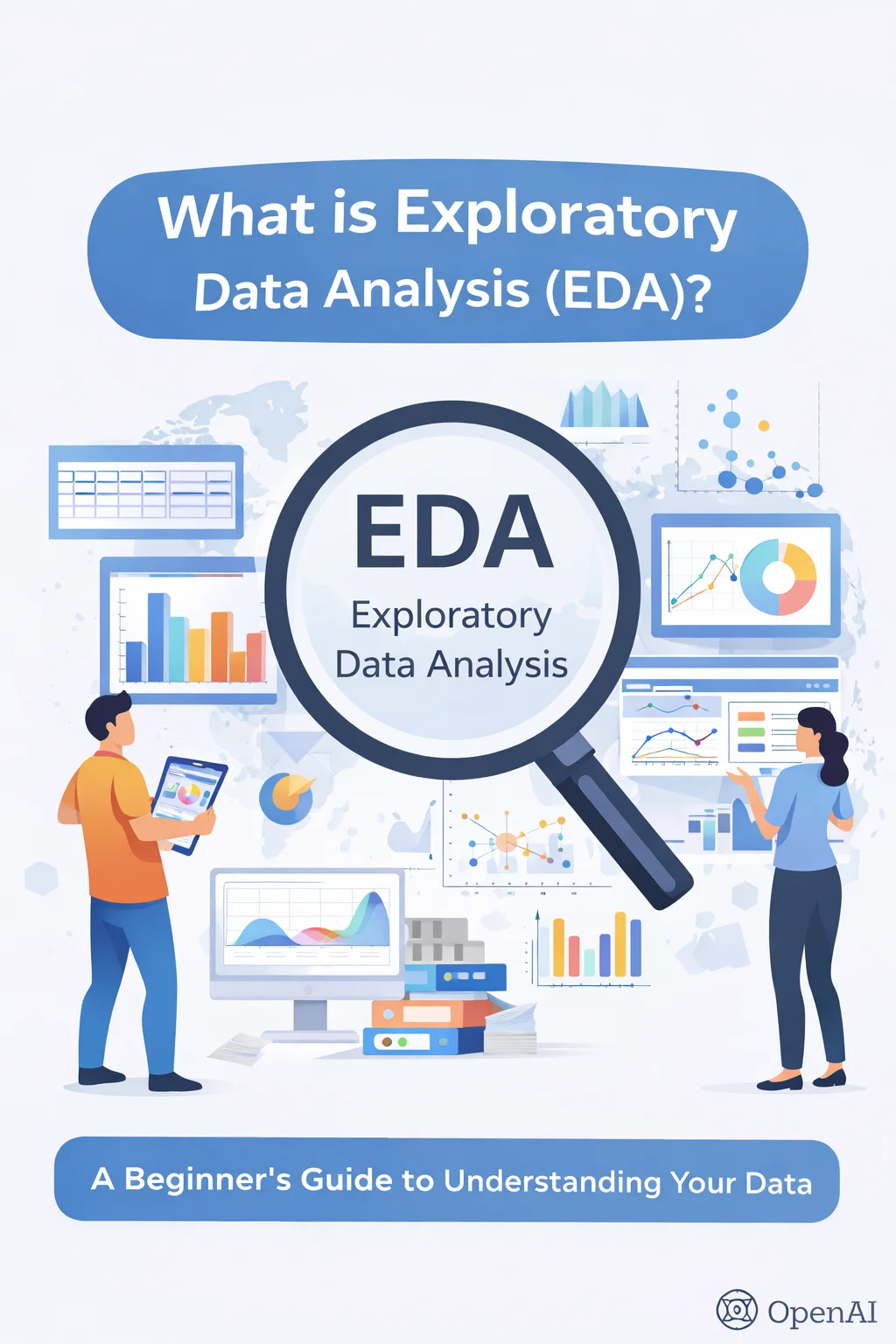
In this guide, we will explore EDA in the simplest way and walk through a clear example so you can understand how it works in the real world.
Exploratory Data Analysis (EDA) is the process of carefully understanding and examining your data, so you can make decisions based on what the data actually shows. Before doing anything with a dataset, it is important to first understand it properly. The first step in any data science project is to sit with the data and observe it carefully. Look at the numbers, understand what each column represents, check for missing values, and notice if anything seems unusual. When you summarize and visualize the data, you slowly begin to understand what it is trying to tell you. This process helps you make better and more accurate decisions because you are working based on the actual data, not on guesses.
What is Exploratory Data Analysis (EDA)?
Exploratory Data Analysis (EDA) is the process of studying a dataset before using it to develop a model. In data science, we usually work with a large amount of data. So it is very important to first study the data properly. We should not directly start applying algorithms without knowing what the data contains.
The idea of EDA was introduced by a statistician named John Tukey. He explained that before making any conclusions, we must explore the data carefully. This means we should not depend only on formulas or tools. First, we must understand the basic nature of the data.
In EDA, we look at the dataset closely. We check what each column represents. We see what type of values are present. We try to find patterns or trends in the data. For example, we may observe if one value increases when another value increases. We also check for unusual or extreme values, which are called anomalies. These values can sometimes affect the result of our analysis.
Another important part of EDA is checking relationships between variables. This helps us understand how different columns are connected to each other. We also test some basic assumptions about the data. For example, we check if the data is evenly distributed or if there are many missing values.
EDA differs from data cleansing and visualization.Data cleaning mainly focuses on correcting errors and handling missing values. Data visualisation is about showing data using graphs and charts. But EDA is a complete process where we analyse, summarise, and understand the data in a deeper way.
In simple words, EDA helps us understand what the data is trying to say. It gives a clear foundation before moving to the next steps in a data science project.
Objectives of Exploratory Data Analysis
Another key responsibility is to check for missing values. In many real-world datasets, some values may be missing or incorrectly reported.Identifying these missing values early helps us avoid problems later.
EDA is also helps to find relationships between different columns. We can determine whether two variables are connected in some way. Along with this, we check for duplicate records, because repeated data can give wrong results.
We also try to understand which aspects are more important and which are less useful. This helps to focus on the right data. In some cases, one category may include more data than another. This is known as class imbalance, and EDA helps us identify it early.
Overall, EDA helps us become familiar with the data and avoids errors by understanding it clearly before moving to the next step.
Where Does EDA Fit in the Data Science Lifecycle?
Data Collection
The first step is to collect data. Data comes from different sources, including surveys, websites, company records, sensors, and online databases. Without data, we cannot start any analysis. As a result, acquiring relevant and reliable data is essential to the project’s success.
Data Cleaning
After collecting the data, the next step is to clean it.In real life, data will not be perfect. It may have missing values, duplicate records, or incorrect entries. At this point, we resolve these issues so that the dataset is reliable and ready for analysis.
Exploratory Data Analysis (EDA)
Once the data has been cleaned, we will proceed to Exploratory Data Analysis. In this step, we carefully examine the dataset. We try to understand patterns, relationships, and odd values. EDA allows us to understand what the data actually shows before developing any models.
Feature Engineering
Feature engineering is the process of introducing new or altering current variables to improve model performance. For example, merging two columns or converting text data into numbers.
Model Building
In this step, we can use machine learning algorithms to the prepared dataset. The model learns from the data and attempts to forecast or categorize based on the patterns it has discovered.
Model Evaluation
Finally, we evaluate the model performance .We use a variety of evaluation methods to determine the model’s accuracy and reliability. If the performance is bad, we should check earlier steps and improve them.
This workflow demonstrates how important each step is. If we skip one step, particularly EDA, it can have an impact on the outcome.
Step-by-Step Process to Perform EDA
Step 1: Load the Dataset
The first step is to load the dataset into our working environment. For this, we import the necessary libraries, which include Pandas, NumPy, Matplotlib, or Seaborn. After that we load the dataset file( usually a CSV file) into the system. And start the analysis.
Step 2: Basic Dataset Information
After loading the data, first we understand its structure. Examine the dataset’s form to determine how many rows and columns are present. And what information included in each column and also examine the data types whether the values are numerical or categorical. Finally, we show the first few rows of the dataset to get a sense of how it appears.
Step 3: Data Cleaning
This step involves good data preparation. We check for missing values and decide whether to fill them or remove them. And also remove duplicate records if needed.. Sometimes data types are inaccurate, therefore we fix them in the correct format. Clean data is crucial for accurate analysis.
Step 4: Statistical Summary
Next, we create a statistical summary of the dataset. Using functions like “describe,” we may see mean, median, lowest, and maximum numbers. We also investigate how the data is distributed. This will allow us to understand the overall behavior of the data.
Step 5: Visual Analysis
This step helps to understand the data more clearly. While using histograms we can see the distribution of numerical values. Boxplots helps to identify spread and possible outliers. Scatterplots help to examine relationships between two variables. A correlation heatmap shows how closely different variables are related to each other. Visualization helps to understand the patterns more easier.
Step 6: Outlier Detection
Outliers are unusual values that differ significantly from the remainder of the dataset. It can be detected by using techniques like Interquartile Range (IQR) or Z-score. Identifying outliers is important because it will affect final results and model performance.
Step 7: Insights Extraction
The final stage in EDA is to write out the correct findings from the analysis.. We need to explain what they mean. After finding patterns and links, we convert them into valuable information for decision-making or model building.

Common EDA Techniques Used in Industry
In real- world,data science projects professionals used different techniques during exploratory data analysis to get a clear and understandable dataset.The most commonly used techniques are
Distribution Analysis
Distribution analysis explains how the values of a variable are spread. For example, we can check whether most values are focused in a single range or evenly distributed. This helps to understand the overall behavior of the data.
Commonly used tools are;
- Histograms
- Density plots
Correlation Matrix
A correlation matrix is used to check the relationship between numerical variables. It demonstrates how strongly two variables are connected to one another. The values normally range from -1 to +1. A value close to +1 indicates a positive relationship. If it is near to -1, it indicates a negative relationship. This will help to identify the important variables.
Missing Value Visualization
Datasets may have missing values.Rather than checking numbers in a table We may use charts to visualize missing data. This makes it easier to see which columns have more missing values.This will lead us to handle it before proceeding to modeling
Feature Importance Check
Feature importance allows us to determine which variables have a higher impact on the target variable. Simply , it tells which attributes are most beneficial for prediction. This helps to focus on important data and avoid unnecessary columns.
Groupby Analysis
Groupby analysis involves categorizing data and obtaining summary statistics. For example, we can divide students by gender and calculate their average marks. This helps to compare different categories and understand patterns clearly.
Time-Series Trend Analysis
When the dataset contains the information like date or time, we use time-series analysis. This helps us to track patterns over a period of time, such as monthly revenue growth or annual performance improvements. And also helps to identify the patterns like seasonal trends or unexpected rises and declines.
These techniques makes more effective EDA and helps us to understand the dataset more clear before developing any models.
Common Mistakes Beginners Make in EDA
When learning Exploratory Data Analysis, there is a chance of making some errors by beginners. These errors can have an impact on the final output. Some of them are explained below;
Jumping Directly to Machine Learning
Many newcomers get excited and they begin with creating machine learning instead of understanding about the dataset. This will give inaccurate or misleading results. This is a big mistake done by them
Ignoring Outliers
Outliers are values that are different from most of the data. They can be significantly higher or lower than other values. Some students ignore them and move on. But these extreme values can change the average and affect the final result. So it is important to check them and decide whether to keep them or remove them.
Misinterpreting Correlation as Causation
Sometimes two variables move together. This is called correlation.But it does not always mean one is the reason for the other. For example, if students who study more get higher marks, it does not mean study time is the only reason. Other factors like teaching quality or interest in the subject can also matter. So we should not assume one thing causes the other without proper proof.
Using too many complicated graphs
Some beginners will use very complex charts to make their work look advanced. But too many complicated visuals can confuse the reader. Simple and clear graphs are always better.
Not writing down insights
EDA is not only about creating charts. We must also explain what we understand from the data. If we do not write our observations clearly, the analysis is incomplete.
Not checking for data leakage
Data leakage happens when we accidentally use information that should not be used while building the model. This can give very high accuracy, but the result will not be correct in real situations. So we must be careful while preparing the data.
Benefits of Performing EDA
Better Model Performance
When we understand the data properly before building a model, the model usually gives better results. This is because we remove mistakes and handle problems in the initial stage.
Better feature Selection
EDA allows us to see which columns are useful. This makes it easier to choose the right features for the model. Using the right features improves the overall result.
Reduced Errors
By checking missing values, duplicates, and unusual data, we can reduce errors in the dataset. Clean and well-understood data results in fewer errors later.
Clear Business Understanding
EDA helps to understand what the data actually indicates. This gives a clear picture of the problem we’re fixing. This makes the analysis more meaningful.
Improved Decision-Making
Finally, EDA helps in improved decision-making. Decisions are based on proper understanding of data and not on assumptions, the final results are more practical and useful.
Real-Life Uses of Exploratory Data Analysis
Exploratory Data Analysis is not only used for assignments or classroom projects. It is also used in real life to understand data and make proper decisions.
In healthcare ,In hospitals, patient details like age, past illness, and test reports are collected. By looking at this information carefully, doctors can understand common health problems and decide the right treatment for patients.
In banking, EDA is used to analyze transactional information.Banks analyze their consumers’ spending patterns. If they notice anything unusual, such as a large transaction or from a different area. It may help to detect fraud. This helps clients from financial loss.
In marketing, companies use EDA to know about their customers. They study customer data like purchase history, age group, or interests. After analysing the data businesses can segment customers and provide better offers and services..
In e-commerce businesses, companies analyse sales data to understand which products are selling more and during which time sales increase. This helps them manage stock properly and plan discounts or special offers.
EDA is also useful in analysing social media data. Companies read comments, reviews, and feedback from customers. By analysing this data, businesses can determine whether people feel positive or negative about their products. This allows them to improve their services.
These examples tell, Exploratory Data Analysis is very useful in the real world.. It helps organizations understand their data clearly before making any important decisions.
Conclusion
In this blog, we learned about Exploratory Data Analysis and its importance in every data science project.We realized , before developing any model, we should carefully examine the dataset. EDA helps us to understand patterns of data,their relationships and problems in the data.
EDA is very important because it provides a strong foundation for the entire project.If we understand the data clearly in the first stage, we can avoid many mistakes later. It also helps in making better decisions and optimizing model performance.
Regular practice is essential for building confidence in EDA. The more datasets you investigate, the better you will understand data behavior.
Start exploring your datasets today before building any model.
Leave a Reply